Why today’s calm market may be the best time to prepare before the next supply shock
You’re sitting on the couch at night. Family is home. Everything feels normal.
Across the world, it isn’t.
Supply chains are tightening. Nations are posturing. Critical materials are being fought over quietly, not loudly. And most people won’t notice until it shows up where it always does first… prices.
This article is about one simple idea: the current ammo market looks stable, but the inputs that determine future prices are not.
The Reality: Ammo Prices Have Come Down
Let’s start with what everyone sees.
Since the peak panic of 2020–2021, ammunition prices have steadily fallen. Shelves are stocked again. Deals are back. The urgency is gone.
That creates a dangerous illusion.
When prices fall, people relax. They delay. They assume stability has returned.
But price is a lagging indicator. It tells you what already happened, not what’s coming next.
Takeaway: Just because ammo is affordable today does not mean it will stay that way.
The Mistake Most People Make
Look at the chart:
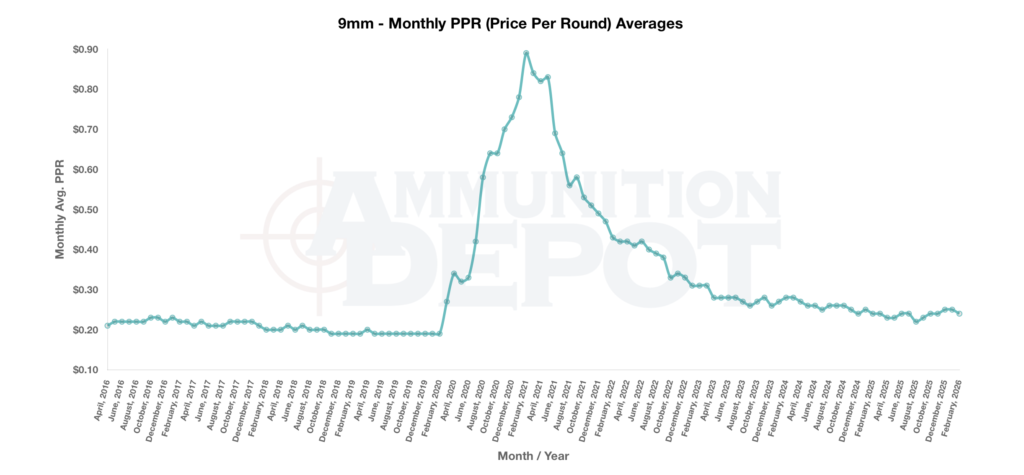
Prices didn’t rise slowly. They exploded.
And what did most people do?
They bought at the top.
Not because they planned to. Because they reacted to fear.
This is human nature. You see it everywhere.
In the stock market, people don’t buy when things are calm and undervalued. They buy when prices are already rising, when headlines are loud, and when everyone else is rushing in.
Ammo is no different.
- When shelves are full, people wait
- When prices are low, people delay
- When scarcity hits, people panic
By the time the average person decides to act, the opportunity is already gone.
Right now, the market feels quiet. Almost boring.
That’s exactly the point.
Boring is when shelves are full.
Boring is when prices are reasonable.
Boring is when no one feels urgency.
That’s when disciplined people prepare.
Takeaway: If you wait until it feels urgent, you’re already late.
What Ammo Is Really Made Of
At its core, ammunition depends on a few key inputs:
- Brass casing (about 70% copper, 30% zinc)
- Lead
- Powder and primers
- Manufacturing capacity
- Transportation and logistics
Of these, copper and zinc are the critical bottlenecks.
Why?
Because they are not just “ammo materials.” They are foundational materials for the modern world.
Copper Is the Center of the Story
Copper is everywhere:
- Power grids
- Data centers
- Electric vehicles
- Military systems
- Infrastructure expansion
- Communications networks
This is not a niche commodity. It is a strategic resource.
What the data shows:
- Copper prices have more than doubled since 2020
- The International Energy Agency projects ~30% demand growth by 2040
- Supply constraints could lead to a meaningful deficit within the next decade
At the same time:
- AI data centers are consuming massive amounts of copper
- Power grid expansion is accelerating globally
- Nations like India are rapidly building infrastructure
- Military demand is increasing due to global instability
This is not theoretical. This is already happening.
Takeaway: Copper demand is rising across every major sector at the same time. Ammo competes for that same supply.
Zinc Matters Too
Zinc doesn’t get the headlines, but it matters.
It makes up roughly 30% of cartridge brass. Without it, you don’t have functional casings.
Recent data from the International Lead and Zinc Study Group shows:
- Continued tightness in global zinc supply
- Demand still outpacing production in key periods
Zinc is heavily tied to industrial production, construction, and manufacturing.
Takeaway: Both components of brass are under pressure, not just one.
The Overlooked Risk: Supply Chains
There is another layer most people miss.
It’s not just about raw materials. It’s about how they move.
A significant portion of global industrial inputs, including sulfur used in metal processing, flows through key maritime chokepoints like the Strait of Hormuz.
When tensions rise in that region:
- Shipping insurance costs spike
- Transit becomes uncertain
- Delays ripple through manufacturing globally
You don’t need a full shutdown to create problems.
Disruption alone is enough.
Takeaway: Ammo pricing is not just a materials story. It’s a logistics story.
Demand Isn’t Slowing Down
Now layer demand on top of constrained supply.
We are living in a time of:
- Ongoing global conflict
- Military rearmament
- Civilian uncertainty
- Increased firearms ownership
Historically, ammo demand spikes during:
- Wars
- Political instability
- Economic uncertainty
Right now, we have all three.
Takeaway: Demand pressure is steady at best, and rising at worst.
What the Chart Doesn’t Tell You
Here’s the critical point most people miss:
Ammo prices today reflect yesterday’s conditions, not tomorrow’s.
We’ve already seen how fast prices can move:
- 9mm went from normal pricing to extreme highs in 2020–2021
- Availability disappeared almost overnight
That wasn’t a slow shift.
It was a snap.
Takeaway: Ammo markets do not move gradually. They move violently when pressure builds.
The Asymmetrical Risk
This is where it becomes practical.
Ask yourself:
- If prices drop further, what’s the upside?
- Maybe 5–10% discount off current price?
- If prices spike again, what’s the downside?
- Potential shortages
- Rapid price increases
- Limited availability when you actually need it
- Cost doubles or more
That’s an asymmetrical setup.
You’re risking very little by being early.
You’re risking a lot by being late.
Takeaway: The downside of waiting is far greater than the downside of acting.
The Protector’s Mindset
At Strategic Defense Academy, we don’t teach panic.
We teach preparation.
Preparation is not about reacting to headlines. It’s about recognizing patterns early and acting decisively.
You don’t stock ammo because you’re afraid.
You stock ammo because:
- You understand supply chains
- You understand human behavior
- You understand how quickly normal becomes abnormal
You prepare while it’s easy. Not when it’s urgent.
Final Thought
Ammo is available. Prices are reasonable. The market feels calm.
But the underlying conditions are not.
Copper demand is rising. Supply chains are tightening. Global instability is increasing.
That combination rarely leads to lower prices over time.
It leads to pressure.
And pressure eventually shows up in price.
Call to Action
If you’ve been waiting for the “perfect” time to buy ammo, understand this:
There is no perfect time.
There is only early… and late.
Prepare. Protect. Prevail.